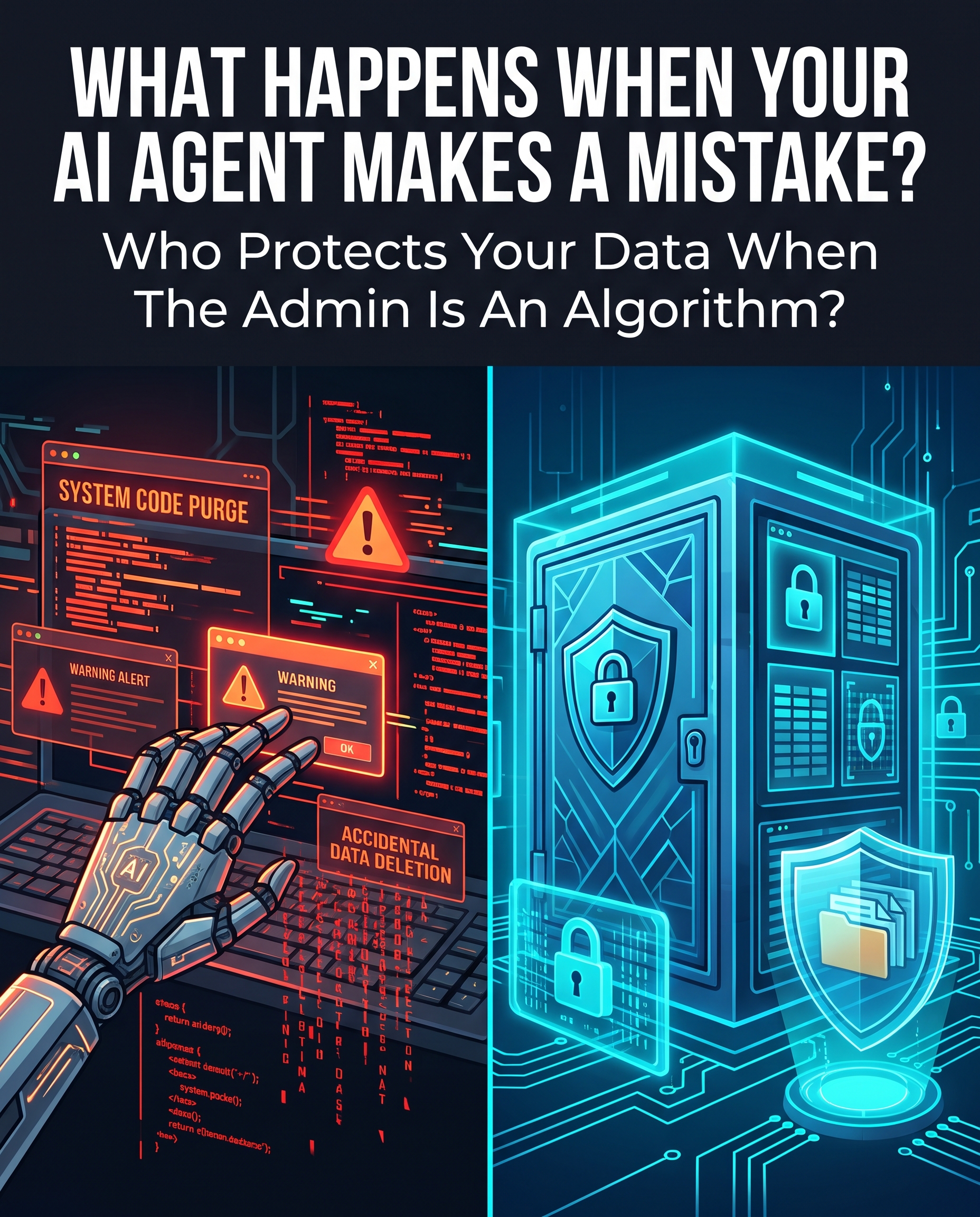
Autonomous AI agents, automated remediation scripts, and intelligent cloud copilots are rapidly driving modern IT operations. From executing cross-cloud database migrations to pruning temporary object storage and standardizing customer pipelines, automation delivers unprecedented operational velocity.
To perform these functions, AI agents are routinely provisioned with elevated administrative authority: Admin API keys, privileged IAM Service Accounts, and direct write/delete permissions.
However, when operational speed increases tenfold, the blast radius of an anomaly increases at the same scale. When an algorithm executes a destructive command with legitimate credentials, standard security perimeters fail to intervene.
1. The Legitimate Execution Paradox: Why IAM and Firewalls Fall Short
Traditional enterprise cybersecurity architectures are designed to repel unauthorized external intrusion. The risk landscape introduced by autonomous AI agents, however, operates within the boundary of trust:
-
Hallucination & Logic Boundary Errors: During automated storage maintenance or database restructuring, an AI agent can misinterpret edge-case conditions or ambiguous prompts, misidentifying mission-critical production directories or active archives as "redundant temporary assets."
-
Authorized Administrative Signatures: When an AI script issues a recursive deletion command (e.g., executing an unconstrained bucket purge or database drop), cloud infrastructure interprets the call as a legitimate, authenticated request. Traditional Identity and Access Management (IAM) controls, multi-factor authentications (MFA), and perimeter firewalls see an authorized API call and execute it instantly without raising an alarm.
2. The Architectural Blind Spot: Shared Blast Radius in Conventional Backups
A common enterprise assumption is that scheduled cloud snapshots offer complete recovery guarantees. However, in heavily automated environments, legacy backup topologies share inherent systemic risks:
-
Policy Alteration & Tampering: If an automation agent possesses administrative orchestration rights across infrastructure, an erroneous script run can modify retention rules to zero days, instantly triggering programmatic data expiration.
-
Unified Administrative Planes: When backup repositories reside within the same permission fabric or management hierarchy as production workloads, the compromise or malfunction of privileged API keys exposes both live environments and backup targets to identical destruction.
3. Mitigating the Unpredictable: Immutable Storage Architecture
Defending against authorized algorithmic errors requires controls embedded deeper than access management—protection must be enforced at the storage layer itself through mathematical immutability:
-
True WORM (Write Once, Read Many) Enforcement: Once an immutable backup point is created, it cannot be modified, overwritten, or deleted by any identity prior to its predetermined expiration timestamp—neither by an autonomous agent, a compromised root administrator, nor vendor technical support.
-
Immutable Policy Locking: System configurations prohibit programmatic API calls from shortening retention policies, stopping recurring snapshots, or overriding compliance locks, neutralizing indirect data loss via parameter adjustments.
-
Logical Air-Gapping: By isolating backup storage and control planes entirely outside the primary production environment (e.g., separating from standard AWS/Azure tenants or on-premises networks), recovery assets remain completely unaffected should production credentials fail.
Frequently Asked Questions (FAQ)
Q1: Can native cloud snapshots prevent accidental AI deletions?
Native snapshots remain vulnerable if the IAM role utilized by the automation agent holds snapshot management permissions. If the credential allows deletion of snapshots, an errant script can purge recovery points concurrently. True immutability prohibits deletion commands at the physical storage controller level regardless of administrative privilege.
Q2: How does immutable backup help if an AI agent corrupts live operational data?
Immutable architecture preserves historical recovery points in an unalterable state. Organizations can instantly roll back to the precise point in time immediately preceding the AI execution, minimizing operational downtime and transactional loss.
Reinforce Your Enterprise Data Resilience
Automation and autonomous intelligence are indispensable drivers of modern efficiency, but business continuity cannot be left to probabilistic outcomes. As enterprises expand algorithmic authority, establishing an immutable, tamper-proof recovery baseline is essential.
To evaluate your multi-cloud and SaaS environments against autonomous script vulnerabilities, connect with the enterprise cloud architecture team at Cloud Ocean Technology.
👉 [Schedule an Architecture Consultation with Cloud Ocean Technologies]
☎:+852 2260 7143